

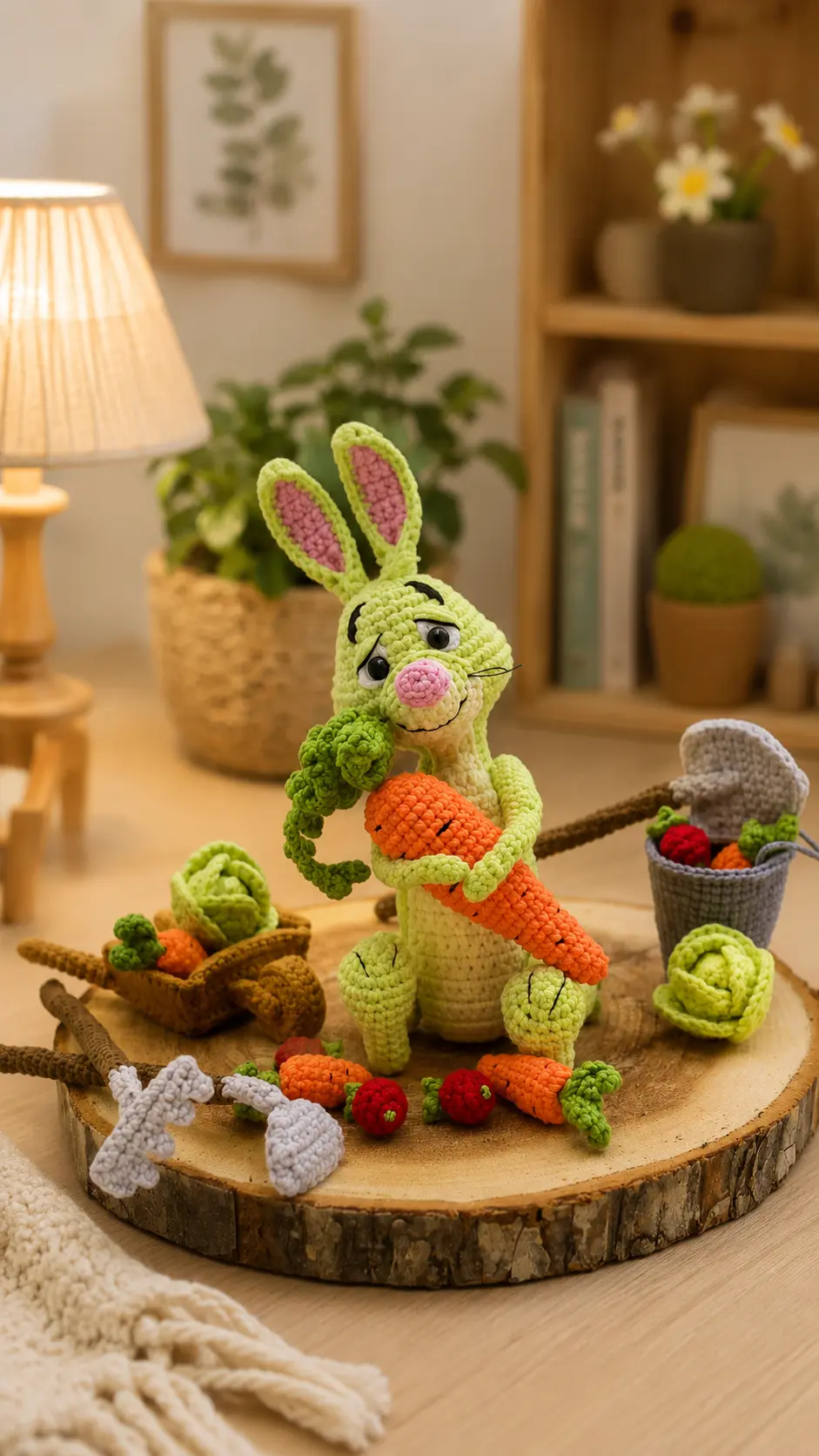
My daughter loves bunnies. She always has. When she was little, she had this stuffed rabbit she dragged everywhere until one ear was barely hanging on. I remember sitting at the kitchen table one Saturday morning, coffee in hand, watching her talk to that raggedy little thing like it was the most important conversation in the world.
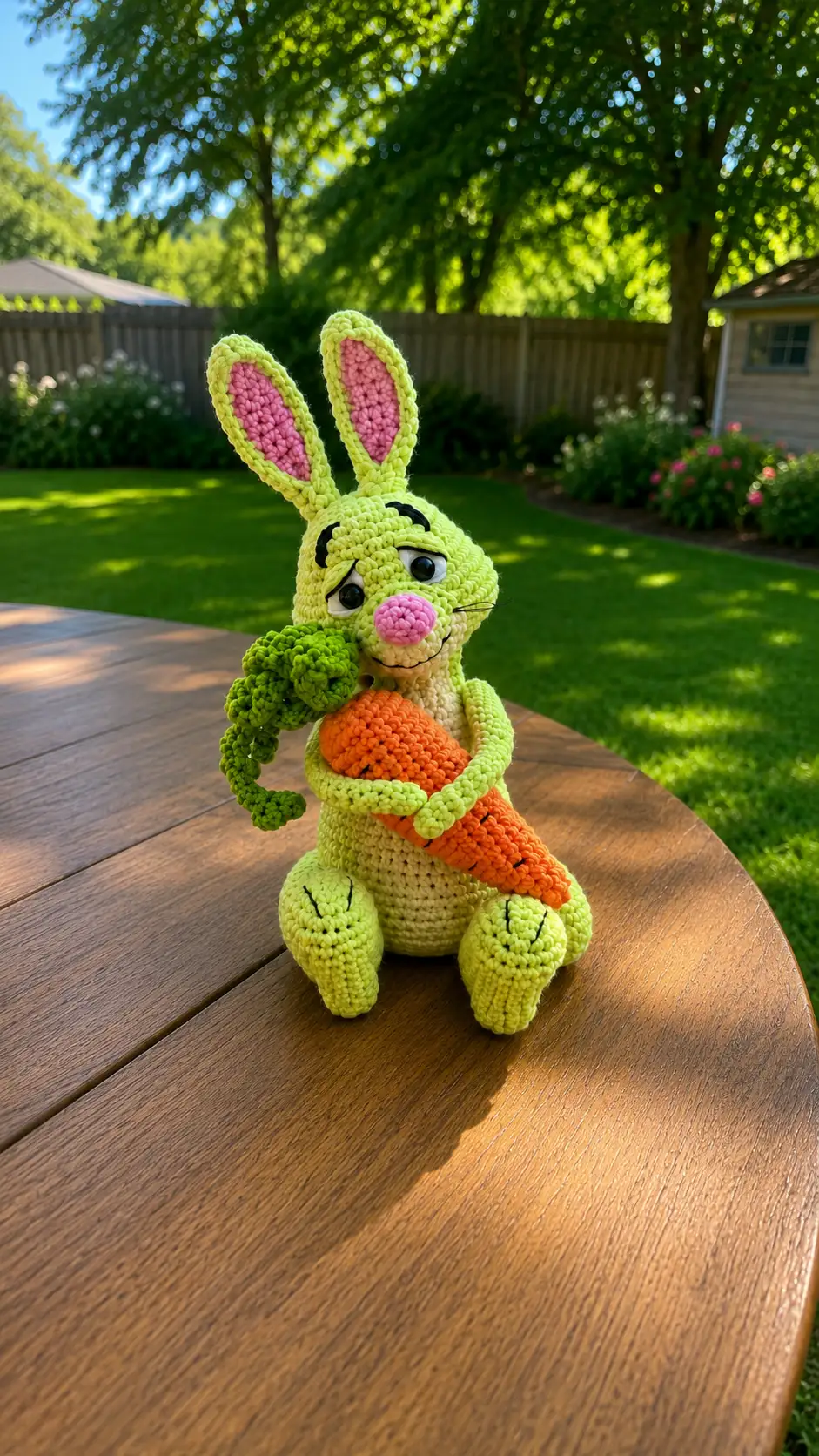
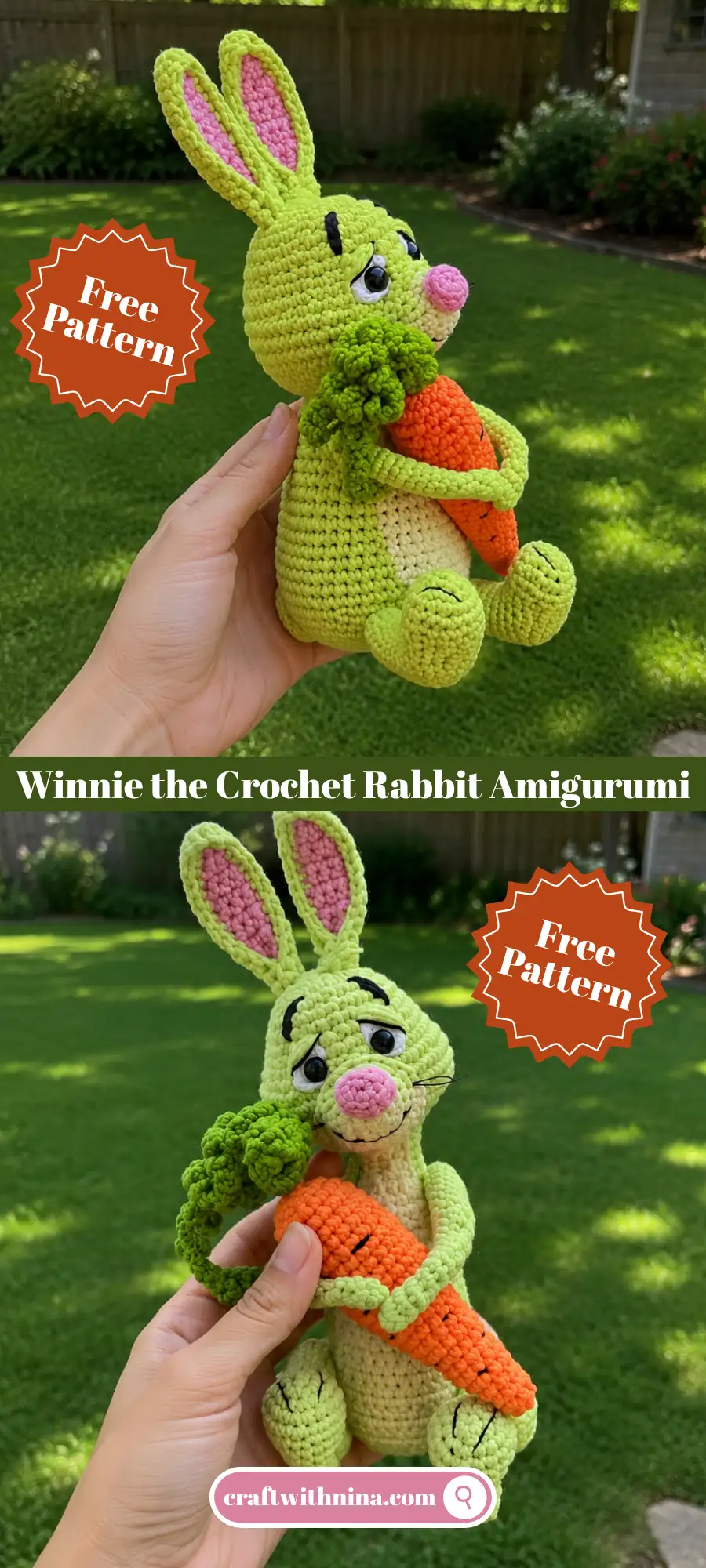
So when I found this pattern for a little green garden rabbit, holding a giant carrot and surrounded by tiny crocheted vegetables, I just smiled. I thought, you know what, she is grown now and would probably roll her eyes at me giving her a toy. But I made it anyway. And she put it on her bookshelf the moment she saw it.
This pattern is detailed and takes some time, but every piece is worth it. You get the full rabbit, a wheelbarrow, a bucket, carrots, cabbages, tomatoes, and little garden tools. It is a whole tiny world you get to build with your own hands.
Materials Needed
Option 1: Small Rabbit
- Semi-cotton yarn, 360 yds/3.5 oz (YarnArt Jeans, Alize Cotton Gold, or Gazzal Jeans):
- White (eye whites)
- Ivory (muzzle, tummy, tail)
- Pink (ears, nose)
- Green (main color: body and all body parts)
- Black (eyebrows)
- Orange (carrots)
- Dark grey (bucket)
- Brown (wheelbarrow, garden tool shafts)
- Light green (cabbage, carrot and tomato leaves)
- Red (tomatoes)
- Grey (shovel, hoe, rake heads)
- 2 mm hook
- 1 pair of safe plastic eyes, 5-6 mm
Option 2: Large Plush Rabbit
- Himalaya Dolphin Baby or YarnArt Dolce, 131 yds/3.5 oz
- Use Himalaya Koala 75724 for tummy and tail
- 3.5 mm hook
- 1 pair of safe plastic eyes, 10-12 mm
Additional supplies for both:
- Thin black thread for embroidering facial features and whiskers
- Thin black sewing thread for whiskers
- Tapestry needle for sewing parts and embroidering
- Synthetic thread for thread mounting of limbs
- Stitch markers
- Pins with large heads
- Scissors
- Fiberfill stuffing
- Love
Finished Size
- Small version (YarnArt Jeans/Alize Cotton Gold): approximately 7.9 in / 20 cm tall
- Large version (Himalaya Dolphin Baby/YarnArt Dolce): approximately 14.6 in / 37 cm tall
Abbreviations (U.S. Terminology)
- MR – magic ring
- CH – chain
- SS – slip stitch
- St – stitch
- SC – single crochet
- BPSC – back post single crochet
BPSC Instructions:
- Step 1: Insert hook from the wrong side of the fabric into the gap to the hook-side of the next stitch to be worked.
- Step 2: Insert hook from front to back around the post into the far-side.
- INC – increase (work 2 stitches in the same St)
- DEC – decrease (2SC together through the front loops)
- BLO – back loops only
- FLO – front loops only
- Rd. – round
- (SC, INC)*6 (18) – repeat the combination in brackets 6 times; the number in brackets is the total number of stitches in the round
Pattern Instructions
Eye Whites
First, crochet the eye whites so they can be attached together with the eyes during the head crocheting process. You can replace crocheted eye whites with pieces of felt.
Make 2 details White yarn
- 0. Chain 4;
- 1. start in the 2nd chain from the hook: 2 SC, 4 SC into the last chain from the hook, on the other side: 2 SC (7);
- Join the oval with a straight line or SS;
- Fix the thread, leave a long end for sewing and withdraw it to the wrong side;
- Insert the eyes in the lower side of the oval so that they are shifted to the center (don’t fix the plug on the eye from the back, if it is available in the kit).
Head-Body
Head and body are crocheted as one detail Green yarn Stuff in process
- 1. 6 SC in MR;
- 2. 6 INC;
- 3. (SC, INC)*6 (18);
- 4. (2 SC, INC)*6 (24);
- 5. 24 SC;
- 6. (3 SC, INC)*6 (30);
- 7. (4 SC, INC)*6 (36);
- 8-9. 2 rounds of 36 SC;
In Rd. 10, mark the beginning of the round with a stitch marker or thread and don’t remove it, because it will be the middle of the back of the rabbit’s head. You will align the beginning of the round in the places indicated below in the pattern, so that the pattern of INC and DEC coincides.
The beginning of the round shifts to the right (for a right-handed person) as you knit, or doesn’t shift at all, which depends on your crocheting technique (the method and strength of the thread tension, the position of the thread relative to the canvas). To align the beginning of the round: work additional shifting stitches, which you DO NOT take into account in the total number of stitches in the round, and shift the stitch marker to the LEFT.
- 10. 5 SC, (SC, INC)*4, 9 SC, (SC, INC)*4, 6 SC (44);
- 11. 5 SC, (2 SC, INC)*4, 10 SC, (INC, 2 SC)*4, 5 SC (52);
- 12-14. 3 rounds of 52 SC;
At this stage, insert the eyes between Rd. 9 and Rd. 10 at a distance of 6 SC. Fix the plug on the wrong side; for safety fastening, you can melt the plastic eye on the wrong side and flatten it. Sew the eye whites with the left end of the thread: the upper edge of the eye white should be 3 rounds above the pupil, the lower edge of the eye white a round below, and the distance between the eye whites is 4 SC.
Shift the stitch (align the beginning of the round) to the middle of the back of the head, if needed.
- 15. 5 SC, (2 SC, DEC)*4, 10 SC, (DEC, 2 SC)*4, 5 SC (44);
- 16. 5 SC, (SC, DEC)*4, 9 SC, (SC, DEC)*4, 6 SC (36);
- 17. (4 SC, DEC)*6 (30);
- 18. (3 SC, DEC)*6 (24);
- 19. (2 SC, DEC)*6 (18);
Pay attention to the shape of the head: well stuffed on the sides (cheeks) and slightly flat in front and back (triangle shape).
Continue crocheting the body:
- 20-22. 3 rounds of 18 SC;
- 23. (5 SC, INC)*3 (21);
- 24. (6 SC, INC)*3 (24);
Shift the stitch marker to the middle of the back (coincides with the middle of the back of the head), if needed.
- 25. 6 SC, (SC, INC)*6, 6 SC (30);
- 26-29. 4 rounds of 30 SC;
Shift the stitch marker to the middle of the back, if needed.
- 30. 2 SC, (SC, INC)*2, (2 SC, DEC)*4, SC, (SC, INC)*2, 3 SC (30);
- 31. 30 SC;
Shift the stitch marker to the middle of the back, if needed.
- 32. 3 SC, (2 SC, INC)*3, 6 SC, (INC, 2 SC)*3, 3 SC (36);
- 33. 36 SC;
Shift the stitch marker to the middle of the back, if needed.
- 34. 3 SC, (3 SC, INC)*3, 6 SC, (INC, 3 SC)*3, 3 SC (42);
- 35-48. 14 rounds of 42 SC;
- 49. (5 SC, DEC)*6 (36);
- 50. (4 SC, DEC)*6 (30);
- 51. (3 SC, DEC)*6 (24);
- 52. (2 SC, DEC)*6 (18);
- 53. (SC, DEC)*6 (12);
- 54. 6 DEC;
- Tighten the hole, fix the thread and hide the end inside the body.
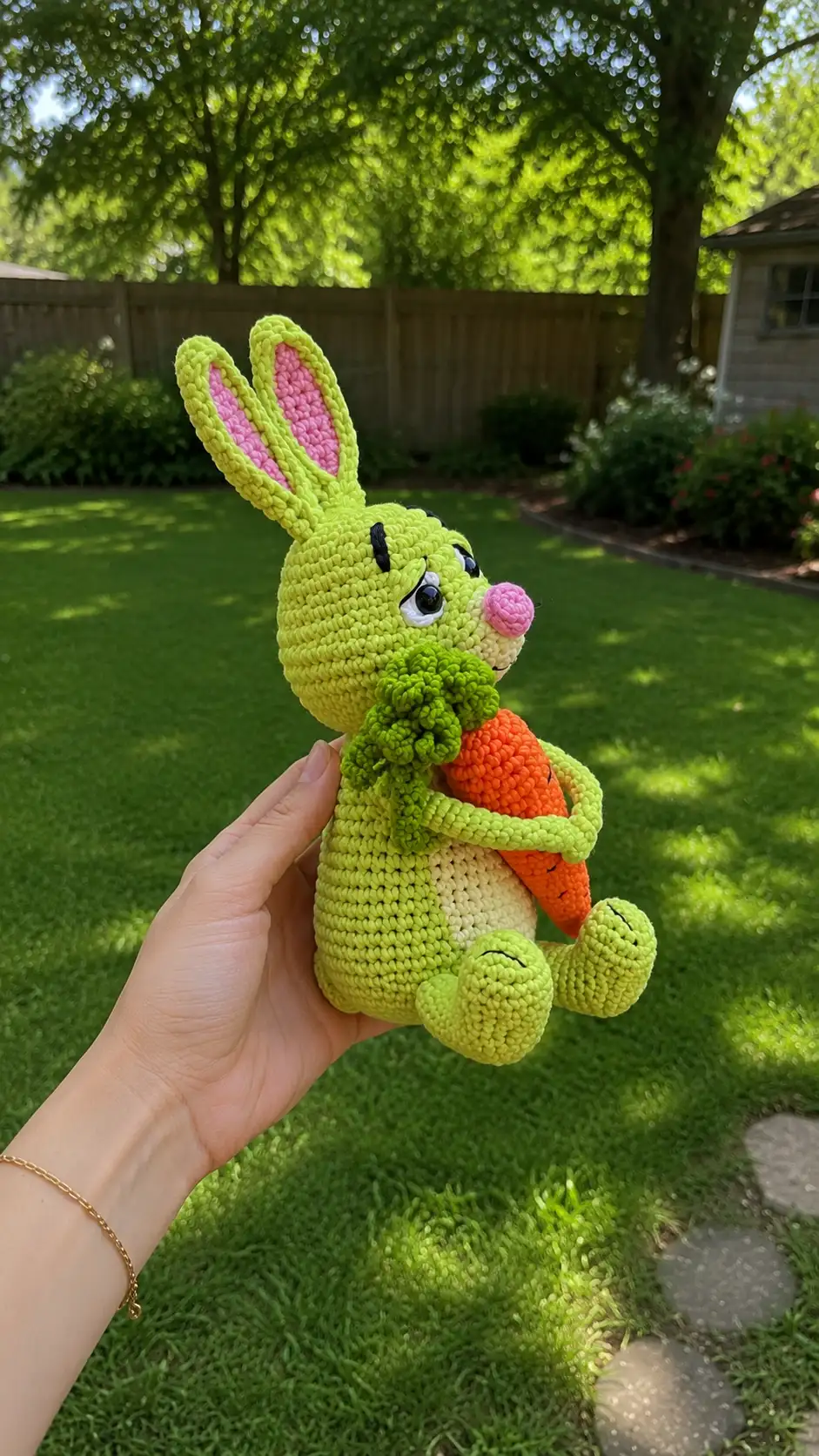
Muzzle
Start with ivory yarn
- 1. 8 SC in MR;
- 2. (SC, 3 SC in the same St)*4 (16);
- 3. 10 SC, 3 SC in the same St, 3 INC, 3 SC in the same St, SC (23);
- Change thread color to green;
- 4. 10 SC, change thread color to ivory, 13 SC (23);
- Change thread color to green;
- 5. 10 SC, change thread color to ivory, fix the green thread and leave a long end to sew, 12 SC, SS (23);
- Fix the thread and leave a long end to sew.
Nose
Pink yarn Don’t stuff
- 0. Chain 4;
- 1. start in the 2nd chain from the hook: 2 SC, 3 SC into the last chain from the hook, on the other side: 3 SC in the same St, INC (10);
- 2. BLO: 10 SC;
- 3. 10 SC;
- Finish with a straight line, leave a long end to sew;
- Sew the nose on the muzzle (above the MR on the muzzle);
- Stuff the muzzle a bit and sew it in the area of Rd. 10-17.
Face Embroidery
- Embroider the eyelids with green thread (the expression of the rabbit’s face depends on the angle of the eyelid);
- Embroider the lower edge of the eyelid with a thin black thread;
- Embroider a smile on the muzzle with a thin black thread: fix the curve of the smile with stitches at the two lower points;
- Embroider the whiskers with a thin black thread;
- Embroider the eyebrows with a black thread several times in the area of Rd. 4-6, so that they are “thick.”
Ears
Inner Part
Make 2 details Pink yarn Make a turn and work a turning CH at the end of each row
- 0. Chain 2;
- 1. in the 2nd chain from the hook: INC (2);
- 2. 2 SC;
- 3. INC, SC (3);
- 4. 3 SC;
- 5. INC, 2 SC (4);
- 6-14. 9 rows of 4 SC;
- Fix and cut the thread;
- Hide the initial and end threads along one side of the detail between the loops.
External Part + Assembly of the Details
Make 2 details Green yarn Make a turn and work a turning CH at the end of each row
- 0. Chain 2;
- 1. in the 2nd chain from the hook: INC (2);
- 2. 2 SC;
- 3. INC, SC (3);
- 4. 3 SC;
- 5. INC, 2 SC (4);
- 6-14. 9 rows of 4 SC;
- Don’t cut the thread; hide the initial thread between the loops;
- Work a CH, attach the pink inner part of the ear with hidden threads inside and crochet two details together with SC along the contour, working 3 SC in the same St in the corners of the details;
- Work a CH, fold the detail in half and work both sides with 3 SS;
- Fix the thread, leave a long end to sew, withdraw it to the base of the ear;
- Sew the ears on the top of the head in the area of Rd. 3-4 of the head (you can change the place of attachment of the ears).
Hair
- Fix a piece of green thread on the top of the head with a knot – this will be hair;
- Separate and trim the threads;
- If you use a plush yarn, then crochet hair with several loop stitches, or you can also fix cotton thread with knots to match the plush yarn.
Tummy
Ivory yarn Make a turn and work a turning CH at the end of each row Semi-cotton yarn can be replaced with textured (fluffy) yarn of the same thickness, e.g. YarnArt Mink, Nako Paris, Alize Softy
- 0. Chain 3;
- 1. in the 2nd chain from the hook: 2 SC;
- 2-4. 3 rows of 2 SC;
- 5. 2 INC (4);
- 6. INC, 2 SC, INC (6);
- 7. INC, 4 SC, INC (8);
- 8-9. 2 rows of 8 SC;
- 10. skip a St, 5 SC, DEC (6);
- 11. 6 SC;
- 12. INC, 4 SC, INC (8);
- 13. INC, 6 SC, INC (10);
- 14-27. 14 rows of 10 SC;
- 28. skip a St, 7 SC, DEC (8);
- 29. skip a St, 5 SC, DEC (6);
- 30. skip a St, 3 SC, DEC (4);
- Work a CH, crochet the detail with SC along the contour, work 3 SC in the same St in the upper corners;
- Finish with a straight line, leave a long end to sew;
- Sew on the body so that the upper edge of the tummy abuts on the muzzle.
Arms
Make 2 details Green yarn Stuff only the upper part of the arm up to the elbow
- 1. 6 SC in MR;
- 2-4. 3 rounds of 6 SC;
- 5. DEC, 4 SC (5);
- 6. INC, 4 SC (6);
- 7. INC, 5 SC (7);
- 8-12. 5 rounds of 7 SC;
In Rd. 13, 2 INC should be on the opposite side from DEC in Rd. 5, since they form the bend of the arm. Shift 2 INC if needed.
- 13. 3 SC, 2 INC, 2 SC (9);
- 14-20. 7 rounds of 9 SC;
- Stuff only the upper part of the arm up to the elbow;
- 21. 4 DEC, don’t work up to the end (5);
- Tighten the hole, fix the thread and hide the end inside.
Legs
Hip
Make 2 details Stuff at the end of crocheting, so that the part remains flat
- 0. Chain 7;
- 1. start in the 2nd chain from the hook: 5 SC, 5 SC into the last chain from the hook, on the other side: 4 SC, INC (16);
- 2. INC, 4 SC, 5 INC, 4 SC, 2 INC (24);
- 3. SC, INC, 4 SC, (SC, INC)*5, 4 SC, (SC, INC)*2 (32);
- 4. 2 SC, INC, 4 SC, (2 SC, INC)*5, 4 SC, (2 SC, INC)*2 (40);
- 5. 3 SC, INC, 4 SC, (3 SC, INC)*5, 4 SC, (3 SC, INC)*2 (48);
- 6. 48 SC;
- 7. 3 SC, DEC, 4 SC, (3 SC, DEC)*5, 4 SC, (3 SC, DEC)*2 (40);
- 8. 2 SC, DEC, 4 SC, (2 SC, DEC)*5, 4 SC, (2 SC, DEC)*2 (32);
- 9. SC, DEC, 4 SC, (SC, DEC)*5, 4 SC, (SC, DEC)*2 (24);
- 10. DEC, 4 SC, 5 DEC, 4 SC, 2 DEC (16);
- Fix the thread, leave a long end and tighten the hole along a straight line, hide the thread inside.
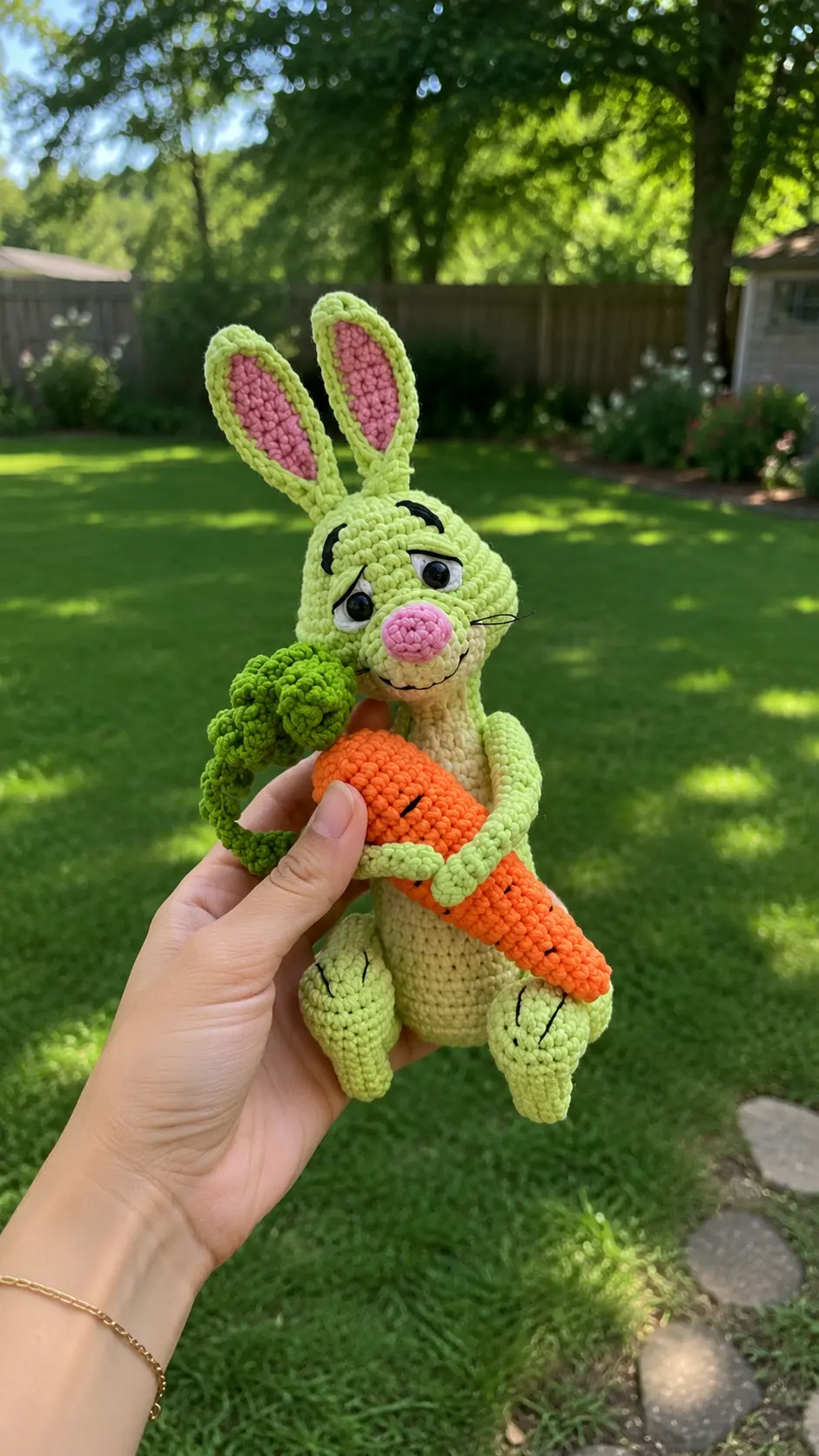
Foot + Assembly
Make 2 details Stuff in process, so that the detail remains flat
- 1. 6 SC in MR;
- 2. 6 INC (12);
- 3. (3 SC, 3 INC)*2 (18);
- 4. 3 SC, (SC, INC)*3, 3 SC, (SC, INC)*3 (24);
- 5. 5 SC, (SC, DEC)*5, 4 SC (19);
- 6. 19 SC;
- 7. 5 SC, 5 DEC, 4 SC (14);
- 8. 14 SC;
- 9. 2 SC, 4 DEC, 4 SC (10);
- 10-13. 4 rounds of 10 SC;
- 14. 5 DEC (5);
- Tighten the hole, leave a long end to sew and withdraw it from above between Rd. 9 and Rd. 10 (the top of the detail is the place of the DEC);
- With a thin black thread, embroider two lines slightly tightening (fingers);
- Sew the feet on the hips.
Thread Mount (Attaching Limbs)
- Mark the attachment area on the limbs: on the arms – the area between Rd. 19 and Rd. 20 on the left and right hand respectively; on the hips – from the side of the hole tightening on the left and right legs, respectively;
- Mark the attachment area on the body: from above – between Rd. 26 and Rd. 27 on the sides; from below – between Rd. 46 and Rd. 47 on the sides;
- Insert a long needle through the body in the place of mounting of the 1st arm and withdraw it in the place of mounting of the 2nd arm;
- Put the arm on the needle taking only the front part of the fabric (not through the whole detail), 2-3 SC and the fiber filling;
- Turn back through the same hole to the initial thread end and put the 2nd arm on the needle;
- Stretch the arms very well and tie the thread ends; hide them in the body through the same (initial) hole, so a knot can hide inside;
To make the mounting easier, use long needles.
- If a knot doesn’t hide, it means you hid the ends not in the same hole; re-do the mounting;
- Do a thread mount of the legs as described above.
Tail
Ivory yarn Stuff not tight Semi-cotton yarn can be replaced with textured (fluffy) yarn of the same thickness, e.g. YarnArt Mink, Nako Paris, Alize Softy
- 1. 6 SC in MR;
- 2. 6 INC (12);
- 3. (SC, INC)*6 (18);
- 4-6. 3 rounds of 18 SC;
- 7. (SC, DEC)*6 (12);
- 8. 6 DEC (6);
- Tighten the hole, fix a thread and leave a long end to sew;
- Sew on the back of the body in the area of Rd. 46-48.
Vegetables and Tools
Wheelbarrow
Bottom Side
Brown yarn (Alize Cotton Gold 02) Make a turn and work a turning CH at the end of each row
- 0. Chain 15;
- 1. start in the 2nd chain from the hook: 14 SC;
- 2-29. 28 rows of 14 SC;
- Work a CH, fold in half and crochet the sides together with 14 SC;
- Fix the thread and leave a long end to attach the details.
Side Wall
Make 2 details Brown yarn Make a turn and work a turning CH at the end of each row
- 0. Chain 15;
- 1. start in the 2nd chain from the hook: 14 SC;
- 2. 14 SC;
- 3. skip a St, 13 SC (13);
- 4. 11 SC, DEC (12);
- 5. skip a St, 11 SC (11);
- 6. 11 SC;
- 7. INC, 10 SC (12);
- 8. 11 SC, INC (13);
- 9. INC, 12 SC (14);
- 10. 14 SC;
- Work a CH, fold in half and crochet the sides together with 14 SC;
- Fix the thread and leave a long end to attach the details.
Front Wall
Brown yarn Make a turn and work a turning CH at the end of each row
- 0. Chain 15;
- 1. start in the 2nd chain from the hook: 14 SC;
- 2-10. 9 rows of 14 SC;
- Work a CH, fold in half and crochet the sides together with 14 SC;
- Fix the thread and leave a long end to attach the details.
Wheelbarrow Assembly
- Steam the details of the wheelbarrow with an iron;
- All parts of the wheelbarrow are joined to each other with a seam of SS (crochet both parts together with SS);
- Join side walls and bottom side;
- Join front wall and bottom side;
- Join corners of the side walls and the front wall;
- Hide the thread ends inside the walls of the wheelbarrow.
Wheel
Brown yarn
- 1. 8 SC in MR;
- 2. 8 INC (16);
- 3. (SC, INC)*8 (24);
- 4. 24 BPSC;
- 5. 24 SC;
- 6. 24 BPSC;
- 7. (SC, DEC)*8 (16);
- 8. 8 DEC (8);
- Stuff the detail keeping a flat shape;
- Tighten the hole, fix the thread and hide the end inside.
Wheel Holder
Make 2 details Brown yarn Make a turn and work a turning CH at the end of each row
- 0. Chain 7;
- 1. start in the 2nd chain from the hook: 6 SC, a turning chain, turn;
- 2. 6 SC;
- Work a CH, fold in half alongside and crochet the sides together with 6 SC;
- Fix the thread and leave a long end to sew to the wheel and to the wheelbarrow;
- Sew details to the wheel and then to the wheelbarrow.
Handle
Make 2 details Brown yarn
- 1. 6 SC in MR;
- 2-10. 9 rounds of 6 SC;
- Fix the thread and leave a long end to sew;
- Sew on the sides of the wheelbarrow from below.
Bucket
Dark grey yarn (Alize Cotton Gold 87)
- 1. 8 SC in MR;
- 2. 8 INC (16);
- 3. (SC, INC)*8 (24);
- 4. (2 SC, INC)*8 (32);
- 5. BLO: 32 SC;
- 6-7. 2 rounds of 32 SC;
- 8. (7 SC, INC)*4 (36);
- 9-11. 3 rounds of 36 SC;
- 12. (8 SC, INC)*4 (40);
- 13-15. 3 rounds of 40 SC;
- 16. (9 SC, INC)*4 (44);
- 17-18. 2 rounds of 44 SC;
- 19. FLO: 44 SC;
- Finish with a straight line, leave a long end for the bucket handle;
- Count 22 St in Rd. 18 and fix the thread on the front loop forming a handle;
- Hide the thread end on the wrong side between the loops;
- Turn back to Rd. 4, attach the thread to the free front loop and work FLO: 32 SC;
- Finish with a straight line, hide the thread ends on the wrong side between the loops;
- A coin can be used as a weighting material (glue it inside to the bottom). (Not recommended for younger children.)
Cabbage
Base
Green yarn (YarnArt Jeans 11) Stuff in process
- 1. 6 SC in MR;
- 2. 6 INC (12);
- 3. (SC, INC)*6 (18);
- 4. 18 SC;
- 5. (4 SC, DEC)*3 (15);
- 6. (3 SC, DEC)*3 (12);
- 7. (2 SC, DEC)*3 (9);
- 8. (SC, DEC)*3 (6);
- Tighten the hole, fix the thread and hide the end inside.
Small Leaves
Green yarn Make 3 details
- 1. 6 SC in MR;
- 2. 6 INC (12);
- 3. (SC, INC)*6 (18);
- Finish with a straight line, leave a long end to sew.
Large Leaves
Green yarn Make 3-4 details, depending on the size of the cabbage
- 1. 6 SC in MR;
- 2. 6 INC (12);
- 3. (SC, INC)*6 (18);
- 4. (2 SC, INC)*6 (24);
- Finish with a straight line, leave a long end to sew;
- First sew small leaves with overlap on each other, so that the upper edge of the leaf is slightly higher than the top of the base;
- Sew on large leaves.
Small Carrot
Base
Orange yarn (YarnArt Jeans 77) Stuff in process
- 1. 6 SC in MR;
- 2. 6 SC;
- 3. (SC, INC)*3 (9);
- 4. 9 SC;
- 5. (2 SC, INC)*3 (12);
- 6-9. 4 rounds of 12 SC;
- 10. 6 DEC;
- Embroider strips with a black thin thread through the open hole;
- Tighten the hole, fix the thread and hide the end inside.
Leaves (Small Carrot)
Green yarn (YarnArt Jeans 69)
- Chain 9;
- start in the 2nd chain from the hook: 7 SC, SS;
- Chain 8;
- start in the 2nd chain from the hook: 7 SC, work SS in the last loop of the first chain;
- Chain 8;
- start in the 2nd chain from the hook: 7 SC, work SS in the last loop of the first chain;
- Fix the thread and leave a long end to sew;
- Sew the leaves on the top of the carrot.
Carrot XXL
Base
Orange yarn (YarnArt Jeans 77) Stuff in process
- 1. 6 SC in MR;
- 2. (SC, INC)*3 (9);
- 3-4. 2 rounds of 9 SC;
- 5. (2 SC, INC)*3 (12);
- 6-7. 2 rounds of 12 SC;
- 8. (3 SC, INC)*3 (15);
- 9-10. 2 rounds of 15 SC;
- 11. (4SC, INC)*3 (18);
- 12-13. 2 rounds of 18 SC;
- 14. (5 SC, INC)*3 (21);
- 15-24. 10 rounds of 21 SC;
- 25. 10 DEC, SC (11);
- 26. 5 DEC, don’t work up to the end (6);
- Embroider strips with a black thin thread through the open hole;
- Tighten the hole, fix the thread and hide the end inside.
Leaves XXL
Green yarn (YarnArt Jeans 69)
- Chain 26;
- start in the 2nd chain from the hook: 4 SC, (chain 4, start in the 2nd chain from the hook: 3 SC, on the base: 4 SC)*5, SS;
- Chain 21;
- start in the 2nd chain from the hook: 4 SC, (chain 4, start in the 2nd chain from the hook: 3 SC, on the base: 4 SC)*4, work SS in the last loop of the first chain;
- Chain 21;
- start in the 2nd chain from the hook: 4 SC, (chain 4, start in the 2nd chain from the hook: 3 SC, on the base: 4 SC)*4, work SS in the last loop of the first chain;
- Chain 16;
- start in the 2nd chain from the hook: 4 SC, (chain 4, start in the 2nd chain from the hook: 3 SC, on the base: 4 SC)*3, work SS in the last loop of the first chain;
- Fix the thread and leave a long end to sew;
- Sew the leaves on the top of the carrot.
Tomato
Base
Red yarn (YarnArt Jeans 56) Stuff in process
- 1. 6 SC in MR;
- 2. 6 INC (12);
- 3-4. 2 rounds of 12 SC;
- 5. 6 DEC (6);
- Tighten the hole, fix the thread and hide the end inside.
Leaves (Tomato)
Green yarn (YarnArt Jeans 69) Leave a long thread to sew at the beginning Crocheted according to the principle of carrot leaves
- Chain 3;
- start in the 2nd chain from the hook: SC, SS;
- Chain 2;
- start in the 2nd chain from the hook: SC, work SS in the last loop of the first chain;
- Chain 2;
- start in the 2nd chain from the hook: SC, work SS in the last loop of the first chain;
- Sew the leaves on the top of the tomato: bring the initial and final threads through the tightened hole to the bottom of the tomato, tie them into several knots and hide the ends of the threads inside through the same hole, so that the knot remains outside.
Garden Tools
Shaft
The pattern is the same for all garden tools.
You can (not necessarily) insert steel or copper (solid) wire with insulated (with a patch) ends inside.
ATTENTION! It is not recommended to use wire in toys for children under 3 years old. If you are not sure of the strength of the wire, then wrap it along the entire length with a patch, so that even with its fracture, the sharp ends cannot injure the child.
Start with brown yarn (YarnArt Jeans 40)
- 1. 6 SC in MR;
- 2-33. 32 rounds of 6 SC;
- Change thread color to grey (Alize Cotton Gold 200);
- 34. 6 SC;
- 35. DEC, 4 SC (5);
- 36-38. 3 rounds of 5 SC;
- At this stage, you can insert a wire;
- Fix the thread and leave a long end to sew.
Shovel
Grey yarn (Alize Cotton Gold 200) Make a turn and work a turning CH at the end of each row Make 2 details
- 0. Chain 10;
- 1. start in the 2nd chain from the hook: 9 SC;
- 2-8. 7 rows of 9 SC;
- 9. skip a St, 6 SC, DEC (7);
- 10. skip a St, 4 SC, DEC (5);
- 11. skip a St, 2 SC, DEC (3);
- 12. skip a St, DEC (1);
- Fix and cut the thread;
- Hide the initial and end threads along one side of the detail between the loops;
- Put two details with hidden threads inside, attach the thread in the middle at the bottom of the details and crochet two details together with SC along the contour, working 3 SC in the same St in the corners of the details;
- Finish with a straight line, fix and cut the thread, hide thread ends inside the detail;
- Sew the shovel on the shaft.
Hoe
Grey yarn (Alize Cotton Gold 200) Make a turn and work a turning CH at the end of each row
- 0. Chain 8;
- 1. start in the 2nd chain from the hook: 7 SC;
- 2-3. 2 rows of 7 SC;
- 4. skip a St, 4 SC, DEC (5);
- 5. skip a St, 2 SC, DEC (3);
- 6. 3 SC;
- 7. INC, SC, INC (5);
- 8. INC, 3 SC, INC (7);
- 9-10. 2 rows of 7 SC;
- Fix and cut the thread;
- Hide the initial and end threads along one side of the detail between the loops;
- Fold the detail in half, crochet three sides together with SC, working 3 SC in the same St in the corners of the detail (don’t crochet the bend line);
- Fix the thread, cut and hide thread ends inside the detail;
- Sew the hoe on the shaft.
Rake
Grey yarn (Alize Cotton Gold 200) Make a turn and work a turning CH at the end of each row
- 0. Chain 12;
- 1. start in the 2nd chain from the hook: 11 SC;
- 2-4. 3 rows of 11 SC;
- Work a CH, fold in half and crochet the sides together according to the pattern:
- 5. SC, (chain 4, start in the 2nd chain from the hook: 3 SC, on the base: 3 SC)*3, chain 4, start in the 2nd chain from the hook: 3 SC, on the base: SC;
- Fix the thread, cut and hide thread ends inside the detail;
- Sew the rake on the shaft.
Tips for Success
Taking on a project this big is something to feel proud of even before you finish. Here are a few things that will make it easier along the way.
Mark your rounds early. This pattern uses a stitch marker to track the middle of the back from Round 10 all the way through the body. Set that marker when the pattern tells you and check it often. It sounds like a small thing, but it keeps the whole shape symmetrical.
Stuff as you go, not all at once. The head and body are one piece, so you need to add fiberfill as you crochet. A little at a time is better than trying to cram it in at the end. Stuff the cheeks well and keep the front and back slightly flatter, like a soft triangle shape.
Thread mounting takes practice. Attaching the arms and legs with a needle and thread rather than sewing them on is worth doing. It lets the limbs move and gives the rabbit a more natural pose. Just be sure to bring both thread ends back through the exact same hole or the knot won’t hide inside.
Use pins before you sew. Before stitching on the muzzle, tummy, ears, or limbs, pin everything in place and step back. Small adjustments in placement make a big difference in the final look.
The face is everything. The expression of this rabbit really comes down to the angle of the eyelids. Take your time with the embroidery. Try a few different angles before you commit. A slightly different slant changes the whole mood from sleepy to happy to a little grumpy, and they are all adorable.
Cotton yarn crochets tight. YarnArt Jeans and Alize Cotton Gold both have a firm weight that makes for clean, neat stitches. If your tension runs loose, go down half a hook size to keep the stuffing from showing through.
Frequently Asked Questions
Can I use a different yarn than the ones listed? Yes, absolutely. The key is to match the weight. For the small rabbit, you want a light sport or DK weight yarn around 360 yards per 3.5 oz skein. For the large version, use a bulky plush yarn in the same weight as Himalaya Dolphin Baby. As long as your hook size and tension match, the finished size will come out close to the measurements listed.
My rabbit came out bigger or smaller than the size in the pattern. What happened? This is completely normal. The pattern itself notes that finished size varies depending on your tension, your crochet method, and how tightly or loosely you work. Everyone crochets a little differently. If size matters to you, make a small test swatch first and adjust your hook size from there.
Do I have to make all the vegetables and tools? Not at all. The rabbit looks wonderful on his own. The vegetables and tools are extras that are totally worth making if you have time and want a full little scene, but you can stop after the rabbit and tail and still have a finished project to be proud of.
The carrot XXL looks hard. Is it beginner friendly? The main body of the carrot uses basic increases and decreases and is very manageable. The leaves are a bit fiddly because of all the little chain branches, but if you work slowly and follow each step one at a time, it comes together nicely. If it feels too tricky, the small carrot is a much simpler version and looks just as sweet.
Is this rabbit safe for children? The pattern uses safety eyes with locking backs, and the arms and legs are attached with thread so there are no hard sewn joints. For children under 3, skip the optional wire in the garden tools and the optional coin in the bucket. Always use appropriate safety eyes for the child’s age group, or embroider the eyes instead.
Conclusion
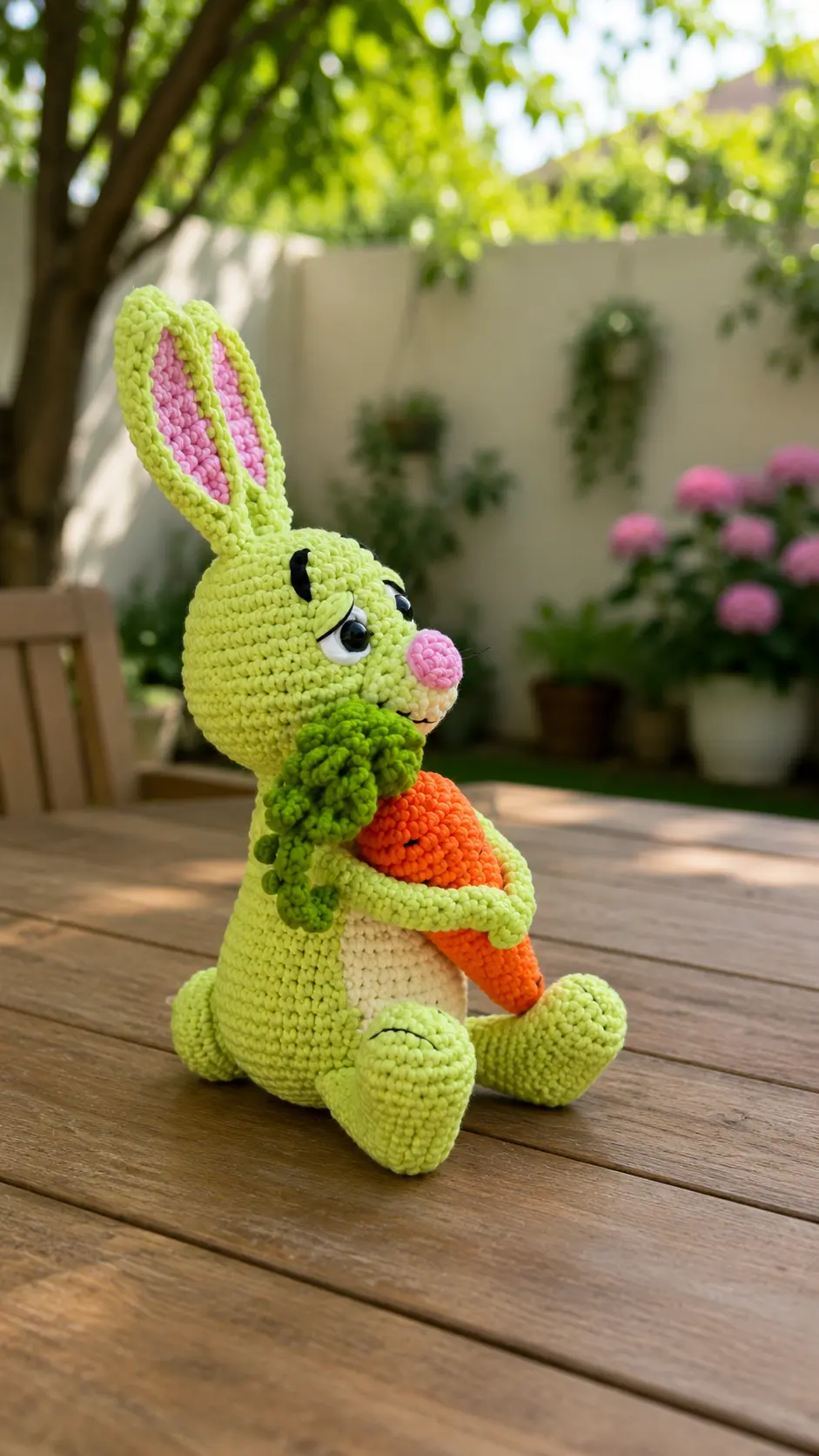
Finishing a project like this one is a real moment. You start with a skein of green yarn and a 2 mm hook, and somewhere along the way, round by round, a little rabbit comes to life. His pink nose, his smirky little grin, his tiny carrot clutched in those bendable arms. It never stops feeling like a small miracle.
I still have the one I made sitting on my windowsill right now, next to a little bucket full of orange crocheted carrots. Every time I walk past him I smile.
If this is your first amigurumi, give yourself grace. If you have made dozens, I hope this one gave you something new to enjoy. Either way, you made something with your hands that nobody else in the world has. That matters more than you know.


Leave a Comment